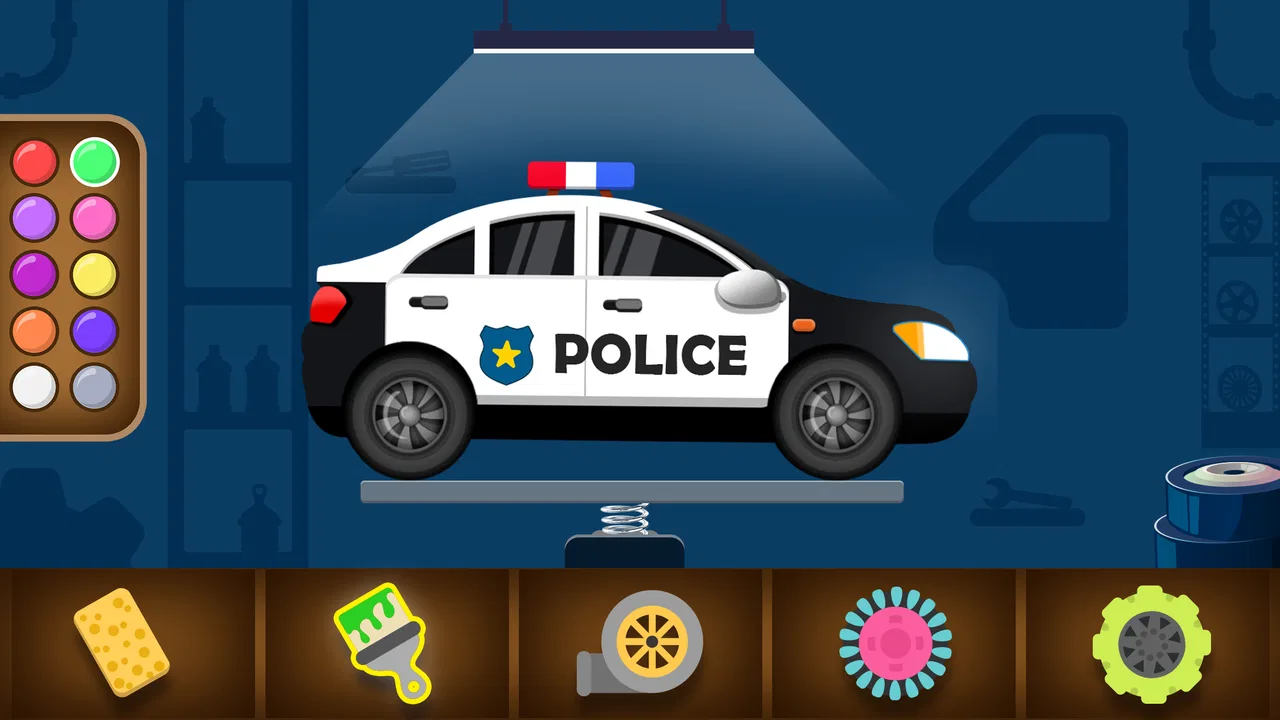
Toddler Car Games For Kids 2-5
- 4.6
- Rating
- 10.00M
- Installs
- Free
- Price

 Analysis by App-foxy
When I tried Toddler Car Games For Kids 2-5, I quickly understood that its main appeal is not speed, competition, or complicated driving. It uses cars as a familiar theme to hold a young child’s attention while turning short play sessions into simple educational activity. That makes it a very different proposition from a racing game: the child is there to explore, react, and learn through playful interaction rather than chase a leaderboard.
This is a free educational game from Toy Tap LLP, aimed at children in the early years and rated for Everyone. It was released on March 18, 2024, and the current version is 4.2.1. Its popularity is easy to understand: it has passed five million installs and holds a 4.6 average from around 4.1 thousand ratings. Those figures do not replace hands-on judgment, but they do suggest that the simple car-and-toddler formula has found a sizeable audience.
Why the car theme works so well for early learning
The strongest capability here is the way the game uses a child-friendly car setting to make basic interaction feel meaningful. A toddler may not be interested in a lesson presented as a lesson, but a colorful vehicle can provide an immediate reason to tap, watch, and try again. In my experience, that framing matters more than sophisticated graphics at this age. The child begins with curiosity about the car, then gradually practices attention, timing, and hand-eye coordination while playing.
You May Also Like

 Blood Strike: 2.5 Anniversary
Blood Strike’s Loadouts Turn Every Drop Into a Tactical Gamble
A close look at Blood Strike’s custom loadouts: how fast access to signature weapons reshapes its battle royale rhythm, rewards preparation, and narrows the gap between fights.

 Pandora - Music & Podcasts
Pandora’s Music Is Easy to Start, but Harder to Recover
Pandora’s strength is its low-effort path from a seed to a station. Its weak spot is how much confidence it asks you to place in connection, setup, and quiet recovery.

 8 Ball Pool
 Is Built on Rivalries, Rematches, and Routine
A close look at the rivalries, rematches, shared routines, and unanswered safety questions that turn a quick pool match into a persistent mobile community.

 Samsung Music
’s Quiet Strength Is Playing What You Already Own
Its reach comes less from spectacle than from dependable access to a personal library. That simplicity is both the app’s strongest retention engine and its ceiling.

 AccuWeather: Weather Radar
AccuWeather Review: A Quick, Clear Forecast for Everyday Decisions
For everyday plans, the best forecast is the one you can understand quickly. AccuWeather makes rain timing, radar, and local conditions easy to act on, with a few trade-offs.

 Hill Climb Racing
Why Hill Climb Racing Still Turns Crashes Into One More Run
A tiny car, a bumpy hill and one more upgrade: Hill Climb Racing keeps resurfacing because its simple chaos makes every near-miss feel personal.
More From Our News Desk



I would describe the experience as guided discovery rather than traditional instruction. It does not ask a young player to read long explanations or understand complex rules before starting. That lowers the entry barrier for children who are still developing language and fine motor control. The car theme also gives parents an easy way to explain what is happening: “Let’s see what the car does,” or “Can you help it?” is more natural than giving a formal tutorial.
The real educational benefit is the repeated connection between a child’s action and an immediate visual response. That feedback encourages experimentation. A child can try again without feeling that a mistake has ended the session, which is especially useful for preschoolers who are still learning persistence. I found this more valuable than any single activity because it supports a habit of observing, acting, and adjusting.
There is also a practical advantage in choosing a narrow theme. A toddler who already likes cars may be willing to spend longer with this game than with a general learning app built around abstract shapes or exercises. That does not make it a complete early-learning program, but it can work as a friendly doorway into screen-based activities that require more than passive watching.
What the central experience feels like
The game is best understood as a collection of short, approachable car-themed moments rather than a serious driving simulator. The intended audience is young enough that realism would probably get in the way. What matters is that the child can recognize the subject quickly and participate without needing advanced control skills.
For a parent, this changes how the app should be introduced. I would not present it as a way to teach road safety, driving, or detailed vehicle knowledge. It is better suited to playful stimulation: helping a child focus on an object, respond to prompts, and enjoy a small success. Keeping that expectation realistic prevents disappointment and makes the app easier to use well.
The Everyone age rating fits the broad, family-oriented positioning. Still, an age label should not be treated as a substitute for supervision. A two-year-old and a five-year-old can approach the same activity very differently. One may need an adult to explain what to touch, while the other may want to explore independently and invent a story around the cars.
How I would use it in everyday life
The most effective sessions are likely to be short and intentional. I would open the game when a child needs a calm activity for a few minutes, then sit nearby for the first attempts. Instead of taking over the device, I would ask the child to predict what might happen before tapping. That small pause turns a reflexive screen interaction into a chance to practice attention and language.
A realistic example would be a child waiting at a medical appointment or sitting quietly while a parent finishes an important task. In that situation, the game can provide a focused activity without requiring the child to understand a complicated menu. I would choose one small session, talk about the vehicle on screen, and stop before the child becomes frustrated or simply starts tapping without looking.
Another useful routine is to play together after a real-world car ride. A parent can connect the virtual theme with familiar observations: wheels, colors, movement, or the sound of a vehicle. This does not turn the app into a structured lesson, but it gives the child a chance to connect screen play with the world around them. That kind of conversation is where much of the educational value can come from.
One tip I found particularly useful is to avoid handing over the game during an already difficult transition, such as bedtime or leaving the house, unless the adult is prepared to end the session clearly. A child who is absorbed in a car activity may resist stopping just as strongly as with any other appealing game. The app works better as a defined break than as an unlimited distraction.
It is also worth letting the child lead occasionally. If the child keeps returning to one type of interaction, that preference can reveal what holds their attention: movement, color, repetition, or the feeling of causing something to happen. A parent can then build a simple conversation around that interest rather than pushing the child through every available activity.
What parents should expect from the controls
The appeal of this kind of toddler game depends heavily on accessibility. Young children are not looking for a control scheme with many buttons, and they may not understand why a tap failed. I found that the best approach is to demonstrate once, then allow the child to try. Repeatedly correcting every touch can turn a playful experience into a test.
Children also vary widely in how they handle visual stimulation. Some will enjoy repeated car movement and bright activity, while others may become overexcited or lose interest quickly. If the child starts tapping randomly, looking away, or asking to switch constantly, I would treat that as a signal to pause rather than as a challenge to complete more of the game.
The game is more suitable for touch-screen use than for a shared family television. A child needs to make direct contact with the device to experience the cause-and-effect loop. That makes it portable, but it also means the adult should think about where the device is placed. A stable position at the child’s level is safer and more comfortable than asking a toddler to hold a larger phone for a long period.
The tradeoffs behind the simple design
Its simplicity is both its strength and its main limitation. A preschooler can begin without a long explanation, but an older child may find the experience too basic after the novelty of the car theme fades. I would choose it for a child who benefits from uncomplicated interaction, not for a child looking for open-ended building, detailed puzzles, or competitive racing.
It also should not replace a broader mix of play. The game can support attention and basic interaction, but it cannot provide the physical movement, social negotiation, imaginative freedom, or hands-on exploration that children get from blocks, drawing, outdoor play, and conversation. I see it as one small tool in a routine, not as a complete educational environment.
The free price makes trying it easy, which is a meaningful advantage for families who want to test the fit before spending money. At the same time, in-app purchases cost $2.99 per item. Parents should be aware of that before allowing unsupervised access to the device. Even when a child cannot understand purchasing, an accidental tap or a request for something extra can create avoidable friction.
That purchase model also affects how I would compare it with completely offline toys or ad-free activity books. A physical toy has no unexpected digital purchase path, while this game offers portability and immediate feedback. The better choice depends on the situation. For a waiting room, the game may be more convenient; for quiet independent play at home, a book or puzzle may encourage a wider range of skills.
Another tradeoff is the screen itself. A car-themed activity may hold attention effectively, but that is not automatically a reason to extend screen time. I would set the duration before starting and use a clear ending phrase. The game is most successful when it fits into the child’s day rather than becoming the default response to boredom.
Compared with ordinary racing games, this title is gentler and more accessible to very young players. Racing games usually reward speed, competition, and mastery of increasingly difficult controls. This one is better for a child who is still learning how to interact with a touch screen. Compared with broad preschool learning suites, it is more focused and potentially easier to start, but likely less comprehensive as an all-in-one learning resource.
Questions I would ask before installing
Would I use it with a two-year-old? Yes, but I would stay close and expect to guide the first session. A child at that age may enjoy the visual response without understanding any larger goal. Would I give it to a five-year-old for independent play? Possibly, especially if that child likes cars and prefers simple activities, although some five-year-olds may want more challenge than this format offers.
Is it useful without an adult sitting beside the child every second? It can be, once the child understands how to interact with it, but I would still keep the device within sight. Supervision is less about solving the game and more about managing time, purchases, posture, and the child’s response to stimulation.
Can it replace a preschool learning app? I would not treat it as a replacement. Its value is narrower: it gives a young child a playful setting for practicing attention and interaction. A more structured learning app may be better when a parent specifically wants language, counting, phonics, or other clearly organized instruction.
Is it a good choice for a child who dislikes cars? Probably not the best first choice. The vehicle theme is central to the appeal, so a child who has no interest in cars may not stay engaged long enough to benefit from the activities. In that case, an art, animal, music, or story-based option would likely be a better match.
Does the current version matter? The app is currently at version 4.2.1, so I would make sure the device has room for the installed version and that the child is using a supported system. It works with Android 7.0 or later. That makes it accessible on many older Android devices, which is helpful if a family keeps a spare phone or tablet for supervised child use.
Who gets the most from this car game
The strongest audience is a toddler or preschooler who is drawn to vehicles, enjoys repeating simple interactions, and is still developing confidence with touch controls. It is especially suitable for parents who want a free starting point rather than a large educational subscription. The combination of a familiar theme, an Everyone rating, and a low barrier to entry makes it easy to test during a short shared session.
I would also recommend it to caregivers who want a conversation starter rather than a silent babysitter. The best results come when the adult names what the child sees, asks what they expect, and celebrates effort without turning the activity into a performance. That approach makes the game more valuable than simply leaving it running while the child taps.
I would skip it for children who need a substantial challenge, children who become overstimulated by screen activity, or families looking for a complete curriculum. I would also skip it when the goal is realistic driving knowledge. The car theme is a playful wrapper, not a substitute for teaching traffic rules or safe behavior around real vehicles.
Toy Tap LLP has made a focused choice here: instead of trying to serve every educational need, the game uses cars to make early interaction inviting. For me, that focus is the reason to install it and also the reason to keep expectations modest. It is not the game I would choose for advanced learning, but it is a sensible option for a young child who needs a simple, friendly activity with an obvious reason to engage.
My final recommendation is positive with conditions. Start with a supervised session, decide how long the child will play, and check the purchase settings before handing over the device. If the child responds warmly to the car theme, the game can become a useful short activity for waiting, winding down, or practicing attention. Its best quality is not that it teaches everything, but that it gives a very young player an approachable reason to look, touch, and try again.
FAQs for Toddler Car Games For Kids 2-5
01What age group is Toddler Car Games For Kids 2-5 suitable for?
Toddler Car Games For Kids 2-5 is designed specifically for young children in the age range of 2 to 5 years old. The gameplay and graphics are tailored to engage and entertain toddlers while also fostering motor skills and early cognitive development. Parents can rest assured that the content is both age-appropriate and educational.
02Does the game include in-app purchases or ads?
Toddler Car Games For Kids 2-5 may include in-app purchases and ads, depending on the version you download. It’s important for parents to check the app settings to manage these features. Some versions offer ad-free experiences or unlock additional content through one-time purchases, providing more control over the child’s experience.
03What educational benefits does the game offer?
The game is designed to support the development of several key skills in toddlers, including hand-eye coordination, problem-solving, and basic counting. Through interactive gameplay, children can learn colors, shapes, and numbers, making it a fun and educational experience that complements early learning in a playful manner.
04Is internet connectivity required to play the game?
While Toddler Car Games For Kids 2-5 can be played offline, certain features such as updates or additional downloadable content might require an internet connection. This allows children to enjoy the game without being online, which is ideal for parents concerned about internet safety and data usage.
05How does the game ensure child safety and privacy?
The app is designed with child safety and privacy in mind, adhering to COPPA regulations to ensure that personal data is protected. Parental controls are available to manage features like in-app purchases and ads, providing a safe and secure environment for your child to enjoy the game.
Pros
- Engaging graphics capture toddlers' attention.
- Simple controls are perfect for little hands.
- Educational content promotes cognitive skills.
- Wide variety of cars keeps gameplay interesting.
- No in-app purchases ensure a safe experience.
Cons
- Limited content may lead to quick boredom.
- Requires frequent internet connection.
- Ads can be distracting for young users.
- Lack of difficulty settings for different ages.
- Sound effects may become repetitive.

Toddler Car Games For Kids 2-5
Gallery